
 Safety is essential whether in the workplace or during recreational activities to avoid the possibility of electrical shock. Boat docks and marinas are places where work and recreational activities occur in the same place. Additions to the National Electric Code (NEC) section 555.3 stipulate the electrical system powering marinas be protected with ground fault detection and interruption. The entire power supplied to docks and boats can be monitored for ground leakage current or each branch circuit can be monitored independently. If there is a fault of 100mA or higher, the power must be disconnected from the source. This low level fault current is generally not enough to trip the circuit breaker protecting the circuit or to open a fuse, but can cause a shock or can damage equipment.
While monitoring the main power would be effective, a fault would cause the main to disconnect all of the power to the marina when there is minimal fault at several of the connected loads. A better approach to detecting fault current so that the majority of the system remains operational is to use fault detection at each power pedestal.
With several boats connected to separate power pedestals, each boat could have small amounts of current flowing to earth ground. Bilge pumps, fans and transformers are common causes of low level fault leakage to earth as the insulation over the windings can develop small cracks. The moisture in the environment helps to make an electrical path to the equipment earth bond. Incorrect or damaged wiring is also common, and electric water heating elements can and do fail, shorting to ground.

AG sensors have an aperture of 0.74 inches, and AGL have an aperture of 1.88 inches. To ensure the wires fit, measure the OD of one wire. Multiply by 2.15 for the OD of a bundle of three wires. Multiply by 2.41 for the OD of a bundle of four wires.
Each of these relatively small amounts of fault current will sum together at the main circuit protection and can easily cause “spurious” tripping. The ground fault sensor detects all fault current downstream from the point where it is installed. If five boats each have low level leakage to earth, say 20mA, the total leakage sensed at the main circuit breaker would be 100mA, and that would trip the ground fault sensor.
Protecting the power to each boat with a circuit breaker equipped with shunt trip mechanism is a better solution. An external fault sensing device surrounds the wires to the power receptacles.
When a fault is detected the sensor closes a circuit to operate the shunt trip mechanism, shutting off power to the single pedestal and the boat or the connected equipment with the problem. The power is restored by pushing the breaker handle back to the closed condition after the problem is identified and corrected.
A contactor can also be used to disconnect the load, although we would recommend selecting a sensor with a latching output. this type of contact action, the power to the operating coil of the contactor is de-energized after a fault is detected and the contactor interrupts the faulting circuit. The sensor is reset by a manual action after the fault is remediated.
Most marinas provide 120/240 VAC single phase power to the docks. The power supplied to each pedestal is usually between 50 and 100 amps. When selecting the proper sensor, be certain to choose one with a window large enough to allow all the current carrying conductors to pass through. The AG Series sensor is large enough to allow up to three #6 THHN to be threaded through the window. The AGL Series can accommodate up to three 300 MCM THHN. The bonding ground wire is not passed through the sensor. The wire feeding the pedestals may be larger than what might be seen in other installations as the distance from the main panel to the pedestals is significant. The wire gauge must be increased to overcome voltage drop. This reduction in voltage should be limited to 5% of the primary circuit voltage.
NK Technologies’ Ground Fault Sensors
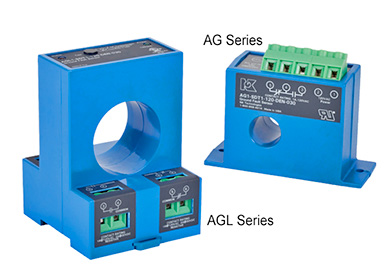 Since the late 1960’s, the National Electric Code has required ground fault circuit protection in many areas; each revision cycle seems to add new requirements More recent versions have added requirements for equipment protection, which are designed to prevent damage from phase to earth faults. Monitoring a three phase circuit for ground fault current requires more than comparing the hot and neutral loads. NKTechnologies’ sensors monitor all current carrying conductors at the same time. If more current is used at the load than is being returned to the source, there is earth leakage. This leakage can be detected by using our extremely sensitive ground fault detection products.